A “Top” School Isn’t Always the Right School: Which Fits Your Child Best?
If you are reading this, you are probably sitting at a dining table covered with school brochures — or closing yet another browser tab comparing “SJKC vs International School” or “SMK or CIS (Chinese Independent School)”.
Choosing a school in Malaysia is no longer simple. With so many pathways, many parents feel confused and pressured to pick a “top” school.
But here is the truth: a top school is not always the right school for your child. Children learn differently, and the best school is one that fits their learning style.
At Zekolah, we see this every year. Students succeed not because a school is famous, but because the school fits them.
This guide will help you choose with clarity — not fear.
Understanding the Malaysian Education System (MOE Overview)
Most schools in Malaysia fall under the supervision of the Ministry of Education (Kementerian Pendidikan Malaysia), which sets the curriculum (KSSR & KSSM), assessments (PBD, UASA), and national examinations such as SPM.
Official reference: moe.gov.my
The main school pathways parents consider are:
- SJKC (Chinese National-Type Primary)
- SK (National Primary)
- SMK / SMJK (National Secondary)
- Chinese Independent Schools (CIS)
- International Schools
- Vocational / TVET Colleges
Each pathway differs in language, assessment style, cost, and long-term outcomes.
1. The Primary School Decision: SJKC vs SK
SJKC (Sekolah Jenis Kebangsaan Cina)
Culture & Learning Style
SJKC schools are known for structured routines, disciplined learning environments, and strong emphasis on Mathematics and Science.
Language Environment
- Mandarin is the main medium of instruction
- Bahasa Malaysia and English are taught as subjects
- Students grow up trilingual from a young age
Best For
- Children who cope well with academic structure
- Parents who value Mandarin proficiency and academic rigor
Reality Check
The KSSR Semakan syllabus is demanding. For families who do not speak Mandarin at home, additional support is often needed — especially from Standard 1 to 3.
Zekolah Insight
Many non-Chinese speaking families succeed in SJKC because they focus on consistent practice, not last-minute cramming. Zekolah’s SJKC past year papers and UASA-aligned exercises help students bridge the gap between classroom teaching and assessment expectations.
SK (Sekolah Kebangsaan)
Culture & Learning Style
SK schools offer a more holistic and multicultural environment, with a generally gentler academic pace compared to SJKC.
Language Environment
- Bahasa Malaysia is the main medium
- English is a core subject and increasingly emphasised
Best For
- Parents who prioritise strong BM mastery
- Families seeking a balanced learning curve
- Students preparing for mainstream national pathways
Key Advantage
Strong Bahasa Malaysia foundation is crucial for future SPM success, public university entry, and many government-linked careers.
2. The Secondary School Crossroad: SMK, CIS, or International?
SMK / SMJK (National Secondary Schools)
System & Exams
SMK schools follow the KSSM curriculum, leading to the Sijil Pelajaran Malaysia (SPM) — Malaysia’s most important school-leaving examination.
Reference: malaysia.gov.my (Education section)
Pros
- Affordable or free
- Recognised nationwide
- Direct pathway to public universities (IPTA)
Challenges
- Larger class sizes
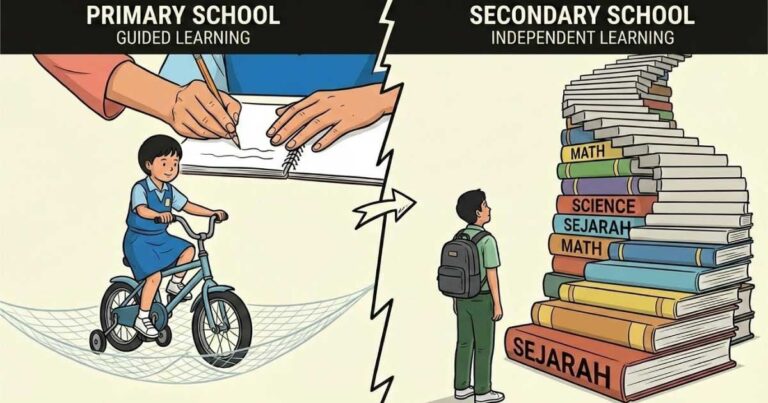
- Students must take more responsibility for revision
Actionable Advice
Because teachers manage many students, success in SMK depends heavily on self-discipline and structured practice. Zekolah’s SPM past year papers and topic-based exercises help students identify weak areas early — before exam pressure builds.
CIS (Chinese Independent Schools)
System & Exams
CIS follow their own curriculum and lead to the Unified Examination Certificate (UEC). Some schools also offer dual pathways (UEC + SPM).
Pros
- Very high academic standards
- Strong Chinese language and cultural foundation
- UEC is recognised by many overseas universities (Singapore, UK, Australia, China)
Cons
- UEC is not universally recognised by Malaysian public universities
Note
Students managing both UEC and SPM face intense academic pressure. Smart study strategies and textbook-aligned practice are essential to avoid burnout while maintaining performance.
International Schools
System
Offer foreign curricula such as:
- Cambridge IGCSE / A-Levels
- International Baccalaureate (IB)
- American syllabus
Pros
- Strong English environment
- Emphasis on critical thinking and presentation skills
- Direct overseas university pathways
Cons
- High fees
- Less exposure to national syllabus and Bahasa Malaysia
- Exams like IGCSE and IB are still academically demanding
Parent Tip
International schools are not “exam-free” — they simply assess differently. Students still need strong fundamentals and exam strategies to succeed.
3. The Underrated but Powerful Option: Vocational (TVET)
Not every child thrives in traditional exam-heavy systems — and that’s okay.
Vocational Colleges (Kolej Vokasional) under MOE focus on hands-on skills, offering qualifications such as:
- Sijil Vokasional Malaysia (SVM)
- Diploma Vokasional Malaysia (DVM)
Official reference: bpltv.moe.gov.my
Best For
- Students who enjoy practical learning
- Careers in engineering, automotive, hospitality, multimedia, IT, and technical fields
Key Advantage
High employability and clearer career pathways — without forcing students through purely academic exams.
4. A Simple Decision Framework for Parents
| Factor | SJKC / CIS | SK / SMK | International |
| Budget | Moderate–High | Low | High |
| Learning Style | Structured, academic | Balanced | Creative, discussion-based |
| Language Focus | Mandarin + BM + English | BM + English | English |
| Main Goal | Trilingual, resilience | Public university | Overseas university |
| Parental Support | High involvement | Moderate | School-driven |
Focus on Fit, Not Fear
There is no wrong choice — only different paths.
Whether your child is in SJKC, SK, SMK, CIS, International, or Vocational education, the students who succeed are not the ones with the “perfect” school — but the ones with consistent study habits and proper support.
Policies may change. Syllabi may evolve.
But one thing remains constant: practice builds confidence.
If your child is on the SJKC, SMK, or CIS pathway, structured revision using past year papers and textbook-aligned exercises can make the difference between stress and steady progress.
At Zekolah, we believe preparation should empower — not overwhelm.