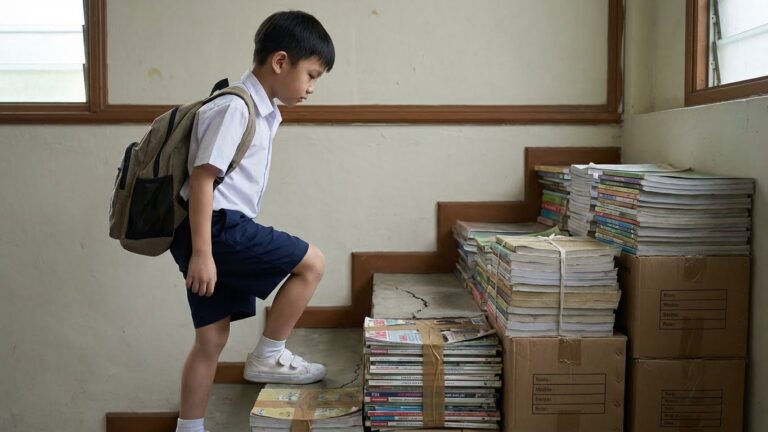
The Standard 4 Math Wall: Why Marks Suddenly Drop
When 90s Turn into 60s Overnight
For many parents in Malaysia, the transition from Standard 3 to Standard 4 feels like hitting an invisible wall. A child who once came home confidently with Maths scores in the 90s suddenly returns with a paper marked in the 60s, or lower.
This drop is unsettling, especially when nothing obvious has changed. The child is still attending school, still completing homework, and often still attending tuition.
Naturally, parents begin to worry:
Have they become careless? Are they losing focus? Is Maths suddenly too hard?
In most cases, the answer is no.
At Zekolah, after analysing student performance patterns and the KSSR Semakan curriculum, we see this dip year after year. What your child is experiencing is not a personal failure, but a structural shift in how Maths is taught and assessed once students enter Tahap 2. We call this transition the Standard 4 Math Wall.
From “Calculating” to “Processing”: The Shift Parents Rarely See
In Standard 1 to 3, Maths is largely about procedural fluency. If a child memorises multiplication tables and understands basic operations, they generally perform well. The core question at this stage is simple: “How much?”
Standard 4 quietly changes that question to: “What is actually happening here?”
This is where the syllabus moves firmly into Higher Order Thinking Skills (HOTS or KBAT). Students are no longer guided step by step. They are expected to interpret information, decide on a strategy, and then execute it correctly.
The Math Wall exists because many students are still using Tahap 1 tools to solve Tahap 2 problems. They can do the Maths—but they can no longer find the Maths within the words.
What Actually Changes in Standard 4 Maths?
On paper, Standard 4 topics look familiar. The challenge lies in how questions are framed.
Earlier years might ask:
Find the total mass of 3 bags of rice if each bag weighs 2 kg.
The operation is obvious.
In Standard 4, the same concept may appear as:
A shopkeeper packs rice into equal bags. The total mass of the rice is 6 kg. There are 3 bags. How many kilograms of rice are in each bag?
Here, the student must first decide whether to divide or multiply. Many children rush—not because they are weak, but because they are not used to choosing the method independently.
Standard 4 also introduces layered questions. A single question may require two or three linked steps. A small error early on can affect the entire answer, often costing several marks.
Another subtle change is the presence of extra information. Students must now decide which numbers matter and which do not. This shift tests thinking discipline, not just calculation skill.
When Maths Becomes a Language and Reasoning Test
Another major reason marks drop is the increase in language demand. Word problems become longer and more detailed. Key instructions are embedded rather than stated directly.
In Malaysia’s multilingual context—especially for SJKC students—this can be challenging. A child may understand the concept perfectly but misinterpret a keyword and lose marks as a result.
This is why parents often say, “My child understands at home, but fails in exams.” The issue is rarely intelligence. It is comprehension under pressure.
Why Even Strong Students Are Caught Off Guard
Ironically, students who did very well in Standard 1–3 are often the most affected. Their success may have relied on speed, repetition, or recognising familiar question types.
When Standard 4 removes those cues, Maths begins to feel unpredictable. Confidence drops—not because ability has declined, but because the expectations have shifted.
For many children, this is their first real academic challenge.
Why Practice Must Change—Not Just Increase
When marks fall, the instinctive response is often to add more tuition or more worksheets. But without changing how a child practises, this can slow progress instead of improving it.
This is why Zekolah structures Maths support by learning phase, rather than treating Standard 4, 5, and 6 as the same problem at different levels:
- Standard 4 Maths focuses on building question-reading skills and structured thinking
- Standard 5 Maths strengthens application across mixed topics and reduces careless errors
- Standard 6 Maths prioritises exam readiness through past year papers and UASA-style questions
Each stage requires a different approach. Using the wrong type of practice too early—or too late—often leads to frustration, confusion, and wasted effort.
Moving from Panic to Pivot: What Parents Can Do Now
Start by identifying where the breakdown occurs. Look at your child’s work. If the method is correct but the final answer is wrong, the issue may be calculation habits. If they don’t know how to begin, it points to a conceptual or interpretation gap.
Next, shift some attention to Maths vocabulary. Spend time reading word problems together. Ask your child what the question is really asking and which words signal the action needed. This builds exam confidence far more effectively than drilling random sums.
Finally, practise with purpose. Generic workbooks often fail to reflect real exam phrasing. Resources aligned to the syllabus and organised by level help students adjust their thinking gradually, rather than overwhelming them.
A Wall That Can Become a Turning Point
The Standard 4 Math Wall is real—but it is not permanent.
It marks the end of the “honeymoon phase” and the beginning of deeper mathematical thinking. With the right guidance, stage-appropriate practice, and patience, most students not only recover but emerge more confident and resilient.
As parents, understanding why this drop happens is the first step. With clarity and the right tools, this wall becomes a turning point—one that prepares your child for the increasing demands of Standard 5, Standard 6, and beyond.